
YAZD
Which desert speaks to you in a whisper, calling without revealing itself? To set out, you need only a little more curiosity. Then a moment comes when you can resist no longer, and you take to the road.
When you finally reach the desert, curiosity falls away. You have travelled one small drop closer to yourself, and once again you remember the words of Bedri Rahmi Eyüboğlu: ‘You are as vast as your solitude; let your solitude carry a sweet fragrance.’
You watch the desert’s absolute silence and the darkness scattered across the night as though watching the dance of burning incense. Either fear makes your steps retreat, or you run towards it. It draws you in, and, spellbound, you drink in the winking of the stars.
With the scent of this singular landscape still upon you, you are steeped in the desert. And then the desert’s storyteller comes alive in your voice. The tale finds a resting place and begins: Once upon a time…
And Yazd unfolds before you
Yazd is one of the places inscribed on UNESCO’s World Heritage List. It is a city of many riches: its culture, geography and human mosaic; its place as a centre of Zoroastrianism; and its location on the ancient Silk Road.
Yazd could be portrayed in many different essays, each with a different title: now as a grain of sand in the desert, now as the heat of the Zoroastrian flame; now through the eyes of Marco Polo, looking upon a city on the Silk Road; and now through the traces of ecological and sustainable ways of living that have endured for centuries. Each glimpse might offer the curious reader just enough excitement to want to see the city in person.
This article explores, through a number of examples, how a sustainable way of life was established amid harsh natural conditions by harnessing gravity, the movement of the wind, and the heat of the sun, with earth as the principal building material.
Let us begin with Yazd’s Water Museum. The museum occupies a house similar in design to the traditional residences we saw in nearby Kashan—one of the city’s historic homes built for a wealthy family.
As you walk through the Water Museum, you realise that people once lived fifteen to twenty metres below ground level. To create a green oasis in a desert where the wind gallops freely, buildings had to be designed in response to the local climate. Below ground were rooms for conversation, as well as spaces for washing dishes and clothes, each with a small pool at its centre. In most old houses, water channels ran beneath the floors. Fed by systems known as qanats, these channels carried water into the houses and linked the dwellings together like a spider’s web. This interdependence also shaped the life of the community. While one household washed its dishes with the clean water flowing through its channel, for instance, the next would wait, since the used water would then pass through its home. Each household therefore had an allotted time and duration for a particular task.
The houses seem almost to float within the sound of water. At the centre of rooms roofed with rounded stone vaults is a small pool built directly over a water channel. The water is always moving, keeping the room cool.
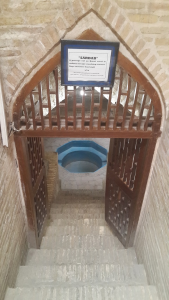
An example of a subterranean room
Another example is the work of those who once waited beside the water to ensure that it was distributed fairly. Their profession was to direct the flow from one plot of land to another. To measure the time, they used either a water clock or a string of prayer beads, counting how many complete circuits they made before diverting the water to the next field.
The water clock had an elegantly simple mechanism. A small bowl with a hole in its base floated in a deeper vessel filled with water. Time was measured by the interval it took for the floating bowl to fill gradually through the hole and sink to the bottom. The allocation of water by this method is striking in both its simplicity and ingenuity.
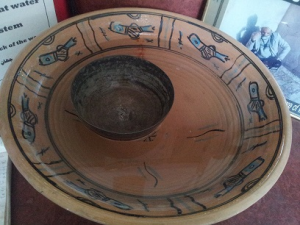
Time measured with a water clock
ICE HOUSES
The ice houses are domed earthen storehouses reminiscent of the beehive-shaped houses of Harran, near Urfa in south-eastern Türkiye. We encountered one in Meybod, not far from Yazd. At the centre of the structure was a large pit, supplied with water from open pools outside. During winter, the cool interior preserved by day the water that froze in the cold of the night. As only a slender beam of sunlight entered through the apex of the dome, a little more water could be added to the pit each morning. Night after night it froze, layer upon layer, eventually forming a mountain of ice. In the dim interior, windcatchers known as badgirs created air circulation and brought in fresh air. Meltwater drained through a hole at the bottom of the pit, preventing stagnant water from collecting and limiting the growth of microorganisms. Once the ice reached a certain height, it was broken into smaller pieces and carried to people’s homes, supplying the community with water until the end of summer.
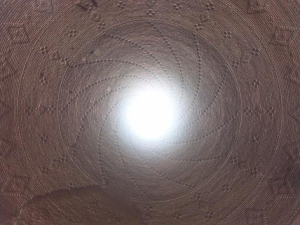
Daylight filtering through the dome of the Meybod Ice House
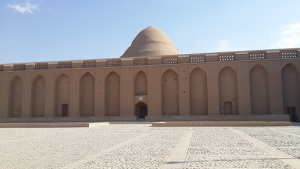
The Meybod Ice House, viewed from outside
From the Towers of Silence, a panoramic view of Yazd makes the spread of concrete buildings across the city plainly visible. Yet a large area is still dominated by old houses. Somewhat dilapidated and partly abandoned, they remain deeply alluring. Built of adobe or a mixture of earth and straw, they are interspersed here and there with brickwork.
Narrow streets are joined like a labyrinth by high walls and vaulted passageways known as sabats, preventing desert dust from easily entering the lanes. Every shade of yellow dazzles the eye.
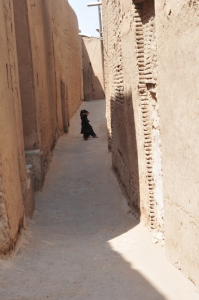
Houses standing shoulder to shoulder along the narrow streets
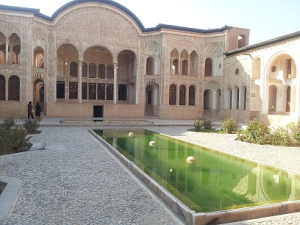
The façades of wealthy homes are remarkably plain. Step through the door, however, and another world appears: a courtyard, a large pool, stained glass and mirrors casting reflections all around. The rooms were positioned according to the seasonal cycle and the changing angle of the sun in winter and summer.
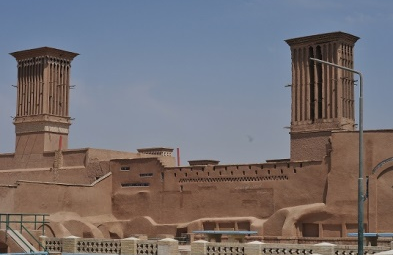
Yazd is a land of windcatchers. In a sea of sand, it resembles a ghost city whose roofs have set sail—its houses drawing in the wind like a funnel and expelling hot air.
Dowlat Abad Garden, now a public park, was once the residence of the ruler Karim Khan Zand. Its long rectangular pool, shaded by cypress trees, is connected to a smaller pool inside the pavilion. Above this small pool rises Yazd’s thirty-three-metre badgir, the tallest adobe windcatcher in the world. The pool adds moisture to the room, helping to cool the hot air entering from above. By exploiting differences in air pressure to create circulation, the badgir keeps the building cool even in the heart of the desert.
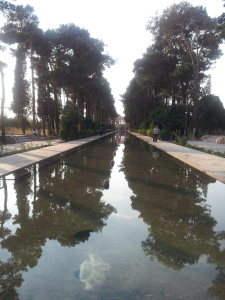
A long pool stretching into the distance at Dowlat Abad Garden
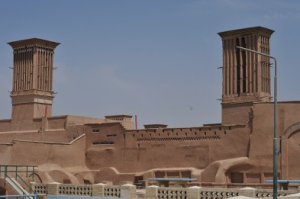
A badgir creating a natural air-conditioning effect inside the building
Before reaching Yazd, we also stopped at Fin Garden in Kashan, completed in 1560. Once again, we found a garden filled with cypresses—a tree of profound significance to Zoroastrians, its evergreen leaves symbolising immortality. Water flows continually through interconnected pools with tile-blue floors, branching like the arms of a river. No mechanical pump is used to sustain this flow. The garden also contains buildings in the architectural style of Kashan’s wealthy houses, richly adorned with finely carved marble. One pool in front of a historic building was especially captivating. Its floor contains more than a hundred openings: some send jets of water upwards, while others draw water down. Together they create a perpetual natural movement across the surface. It is said that the pool was once lined with gold; when sunlight fell upon the water, patterns reminiscent of a Persian carpet shimmered across the façade of the building opposite. The refined aesthetic sensibility and skilful engineering handed down across the centuries continue to astonish visitors.
QANATS
Water was carried by qanats to the pools and houses of Yazd in the middle of the desert. To my ear, the Turkish word kanat—‘wing’—evoked giant birds carrying rain-laden clouds on their long, powerful wings: flocks answering the prayers of a drought-stricken people, bringing water from the far side of the world and pouring it down as the people rejoiced. A qanat, of course, is not a bird’s wing. Constructing such a system demanded immense physical labour and sophisticated mechanical knowledge.
It required digging underground channels to carry water into the city from sources many kilometres away; excavating both vertical shafts and horizontal tunnels; installing artificial cascades underground to temper the powerful current in tunnels descending steep slopes; and placing waterwheels in those cascades. More than 50,000 qanats are known to exist in Yazd and the surrounding region, some conveying water from the mountains to settlements through channels extending over forty kilometres.
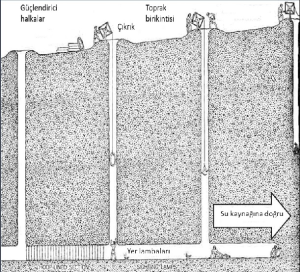
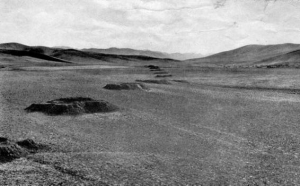
Seen from above ground, a qanat system resembles craters on the surface of the Moon
PIGEON TOWERS
To call them pigeon houses hardly does them justice: entire towers were built of earth for the birds. The inner walls are patterned with countless small niches, each one a nest. With sunlight filtering delicately across their surfaces, these towers could shelter more than two or three hundred birds. Pigeon droppings are still used as agricultural fertiliser today.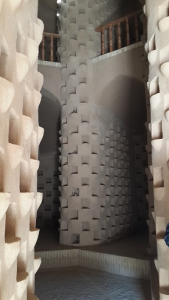
Living in a desert ruled by harsh natural conditions, the people of the region created works of engineering that responded harmoniously to the distinctive qualities of their environment, while also expressing a refined artistic sensibility. Their designs have remained functional for centuries. The principles of permaculture and sustainable living reveal themselves almost everywhere in the traces of the past. For anyone interested in energy efficiency, architecture and ecology, Yazd is a place well worth seeing.
All rights reserved. Excerpts may be quoted with proper attribution.
August, 2013
Dilek Ekşi Bilgin
@hayyalsen