
YAZD
Which desert speaks to you in a whisper, calling without revealing itself? To set out, you need only a little more curiosity. Then a moment comes when you can resist no longer, and you take to the road.
When you finally reach the desert, curiosity falls away. You have travelled one small drop closer to yourself, and once again you remember the words of Bedri Rahmi Eyüboğlu: ‘You are as vast as your solitude; let your solitude carry a sweet fragrance.’
You watch the desert’s absolute silence and the darkness scattered across the night as though watching the dance of burning incense. Either fear makes your steps retreat, or you run towards it. It draws you in, and, spellbound, you drink in the winking of the stars.
With the scent of this singular landscape still upon you, you are steeped in the desert. And then the desert’s storyteller comes alive in your voice. The tale finds a resting place and begins: Once upon a time… And Yazd unfolds before you.
Yazd is a desert tale.
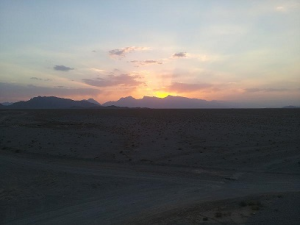
There are two great deserts in eastern Iran: Dasht-e Kavir and Dasht-e Lut. Yazd stands where the two meet, in a place that is almost an oasis. Dasht-e Lut is thought to have once been covered by sea. Its surface is not sandy but hard, and in many places it is veiled by a fine crust of salt. Here and there, low-growing plants bloom like cauliflowers. This is not like the Arabian deserts with their endless dunes. The mountains are sun-scorched guardians where the earth has risen to its feet, themselves part of the desert.
Within such a landscape, the traces of a civilisation that has adapted to the desert over thousands of years continually make themselves felt. Yazd deserves more than one visit—for its nature, its architecture and its way of life.
A CITY OF CARAVANSERAIS
The Zein-o-Din Caravanserai dates from the reign of Shah Abbas, although it is not one of the celebrated 999 caravanserais said to have been built for Silk Road trading caravans between 1576 and 1585. According to local legend, the people of the region rose against the governor of Kerman, refusing to pay their taxes. Their protests spread in waves until news reached Shah Abbas, who came in secret to investigate their grievances and concluded that their complaints were unfounded. But was that truly so? History most often reaches us through the pens of those who hold power. To continue the story: when the governor later learnt of the Shah’s visit, he was mortified and ordered a caravanserai to be built in Shah Abbas’s name, so that he might be received there as an honoured guest should he return. The caravanserai stands about an hour’s drive from the centre of Yazd. It has been restored and now operates as a hotel.
With no other settlement anywhere around it, the caravanserai gives you the uncanny feeling of having travelled back several centuries.
On the upper floor, as you sit embraced by the stars, Marco Polo suddenly steps out of Italo Calvino’s Invisible Cities, and you listen:
Marco Polo describes a bridge, stone by stone.
‘But which stone supports the bridge?’ Kublai Khan asks.
‘The bridge is supported not by this stone or that one,’ Marco replies, ‘but by the curve of the arch they form.’
Kublai Khan falls silent and reflects for a while. Then he says:
‘Why, then, do you tell me about the stones? The arch is all that matters to me.’
Marco answers: ‘Without the stones, there is no arch.’
A caravanserai would hardly be a caravanserai without the rounded contours of its stone architecture, softening the desert; the Persian carpets covering almost every surface; the magnificent hospitality of Rashid from Balochistan, who attends to every detail; and, of course, a performance of his traditional Balochi dance.
Marco Polo also wrote of Yazd, although this caravanserai did not yet exist in his time. Records show that he visited the city in 1272.
CHAK CHAK AND THE FIRE TEMPLE
Another of the desert’s mysteries is Chak Chak, a name that means ‘dripping’. It is sacred to Zoroastrians, and every June pilgrims arrive from around the world. During the pilgrimage, the site is closed to non-Zoroastrian visitors. In a small grotto embedded in the mountain, water seeps delicately from the rock. According to legend, Nikbanou, the second daughter of Yazdegerd III—the Zoroastrian Sasanian ruler of Iran before the Islamic conquest—fled to this mountain and prayed to Ahura Mazda not to let her be captured by the Arab armies. The mountain opened and took her into its embrace. The dripping water is said to be Nikbanou’s tears, while the ancient tree beside the cave is her staff, symbolising wisdom.
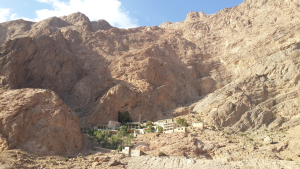
Set into the mountainside amid the desert’s yellows, the small sacred shrine is reached by a steep flight of steps and surrounded by greenery. Around it are lodgings built for pilgrims: roofed concrete structures in which many people can sleep side by side, seemingly stacked one above another against the mountain. Inside the sacred grotto, a fire burns beside a brazier shaped like a lotus, with twelve petal-like sections.
The fire in the brazier is lit from time to time; unlike the flame in the Fire Temple in central Yazd, it does not burn continuously. Its twelve petals represent the twelve months of the year. In Zoroastrian belief, nature and the four elements—air, water, fire and earth—are of great importance, and traces of all four can be seen in the fire temples. Zoroastrians do not worship fire; theirs is a monotheistic faith. Rather, through the qualities of fire, they perceive the Divine.
FIRE HOLDS A SACRED PLACE IN ZOROASTRIANISM
- Fire points upwards; it always seeks to rise. In the same way, as human beings release their burdens, they become lighter, more refined, and rise.
- Fire transforms everything. It consumes what is unwanted; it cleanses and purifies. Even when it has turned to ash, its warmth can still be felt: its presence remains. In old age and illness, too, human beings are called to continue radiating their own light, as fire does.
- Wherever fire enters, its warmth makes its presence known. Human beings, too, are expected to offer one another warmth.
- Fire is the light of God.
God is Ahura Mazda. The meaning is held within the name itself: Ahura, the one who gives all to every created being; Maz, great; and Da, wisdom. Together, they signify the Creator. The Avesta is the sacred scripture of Zoroastrianism.
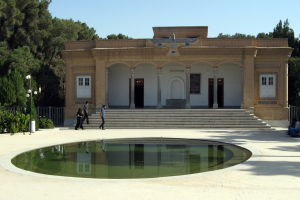
The flame burning in Yazd’s Atash Behram is regarded as the highest grade of sacred fire. Its continuity is entrusted to a senior priest known as a hirbod, who feeds it with apricot or almond wood. The flame is said to have burned without interruption for 1,500 years.
Above the entrance to the temple is the Faravahar, a symbol expressing the Zoroastrian way of life.
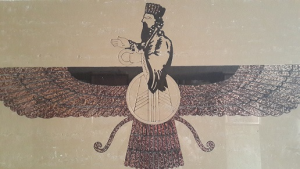
The elderly figure represents wisdom. The ring in his hand, like a wedding band, signifies fidelity to God; his raised right hand points towards the divine path; and the large circle at the centre represents the cyclical nature of life. The curved extension beneath the wings at the front signifies keeping good things before us, while the one behind signifies leaving evil behind. The wings represent spiritual ascent. Their three layers recall the maxim ‘Good thoughts, good words, good deeds.’ By contrast, the three layers of feathers beneath the wise figure represent ‘Bad thoughts, bad words, bad deeds’—the forces that weigh a person down and hinder spiritual elevation.
Although the Faravahar is associated with Zoroastrianism, it has also been used as a national symbol in Iran. It was not prohibited after the Iranian Revolution of 1979, whereas the lion-and-sun emblem of the royal coat of arms was banned because of its associations with the pre-revolutionary monarchy.
THE FIRE TEMPLE
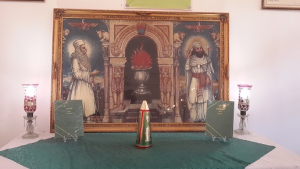
Cyrus—Kurush in Old Persian—the ‘King of Kings’ who ruled from 559 to 530 BCE, was a follower of Zoroaster. He earned this title because his realm extended from Macedonia in the Balkans to the Indus River in the east. In one of the images inside the Fire Temple, a flame appears at the centre, with Zoroaster on the left and Cyrus on the right. Another striking object is the sacred sugar wrapped in green and gold. The sugar carries the wish for a sweet life, while reminding us that it is we who must make life sweet.
Whether this explains why Yazd’s confections are so sugary is impossible to know! Qottab and baklava are among the city’s traditional sweets. Qottab resembles a crumbly shortbread, but is filled with almonds and flavoured with rosewater and cardamom. Yazdi baklava is dry and exceedingly sweet.
A fire temple has also been discovered in Türkiye. Excavations at the ruins of Ani, near Kars on the Armenian border, revealed a fire temple dating from between the first and fourth centuries CE; it is also mentioned in the writings of the Greek geographer Strabo.
DAKHMEH—THE TOWERS OF SILENCE
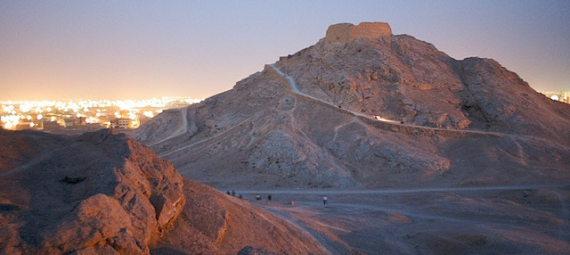
One of the finest panoramic views of the city can be seen from the twin Towers of Silence, two kilometres outside Yazd. Although concrete development and multi-storey buildings are visible, the city still holds the yellow of the sun within its earthen walls. The word ‘tower’ may conjure the wrong image: these structures resemble two immense fortresses formed from mounds of earth. A narrow, gently curving earthen path leads upwards, and the summit is encircled by a stone wall. Until the 1960s, Zoroastrians placed their dead here for birds of prey.
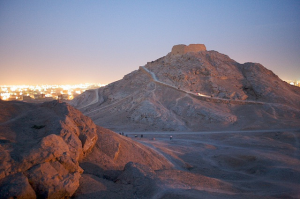
In much earlier times, bodies were left not on towers but in remote places far from settlements. As the exposed remains decomposed, however, diseases carried by rodents began to appear in the city. Moving the bodies to the towers offered a solution, since few animals could climb them.
After an attendant known as a salar had washed the body and priests had completed the rites of blessing, it was placed beside the other dead in the outermost ring of the tower. When the birds had consumed the flesh, the remaining bones were carried to a cylindrical ossuary at the centre, divided into four sections for women, men, children and those who had died of illness. Once completely dry, the bones were dissolved with acidic water.
To minds accustomed to burial or cremation, this practice may initially seem strange. Yet it rests upon a profound belief: in Zoroastrianism, the human body must not contaminate earth, water, air or fire. The towers also made it possible for rich and poor alike to be laid side by side, regardless of social standing, and to share the same funerary rite. The dead person’s final act of generosity was to become nourishment for birds.
THE JAMEH MOSQUE AND ITS TILEWORK
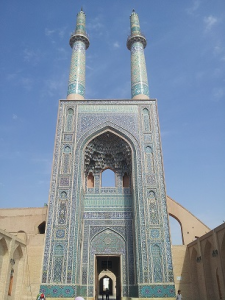
With its monumental entrance portal and soaring minarets—the tallest in Iran—the Jameh, or Friday, Mosque offers magnificent examples of tilework. Throughout the rest of the mosque, dazzling blue and green tiles form intricate geometric patterns.
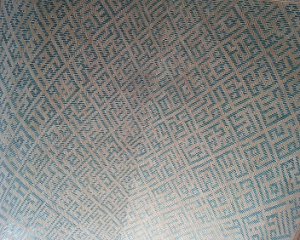
The motif in the photograph below is part of the decoration on an interior ceiling. It is, in fact, calligraphic script known as Kufic banna’i. Sometimes described as mosaic calligraphy, it resembles a labyrinth and most often uses deep navy and blue tones. It incorporates 110 different names of God. In Shia tradition, 110 is a sacred number; according to the abjad system of numerical values, it corresponds to ‘Ya Ali’—‘O Ali’.
YAZD’S ARCHITECTURE: THE WATER MUSEUM AND DOWLAT ABAD GARDEN
The architecture of Yazd, its windcatchers—or badgirs—and the qanat systems that brought water into the city deserve an article of their own.
Let us begin with the Water Museum, housed in a mansion and its garden. The walls are off-white, carved with the delicacy of stone lace and inset with tiny mirrors. At certain angles, daylight plays across their surfaces. Throughout Yazd and the surrounding region, light and water are fundamental elements of architectural design.
The people of Yazd did not live only above ground; they created living spaces fifteen to twenty metres below the surface. Water carried from many kilometres away through subterranean channels linked the houses like a web. This interdependence also shaped community life. While one household washed its dishes with clean water flowing through its channel, for example, the next household would wait, since the used water would then pass beneath its home. Each family therefore had an allotted time and duration for particular tasks. In houses that seemed to float within the sound of water, rooms had rounded stone vaults and small pools at their centres. Built directly over the channels, these pools maintained a constant flow of water and helped keep the rooms cool. The museum contains a wealth of visual material showing how the waterways were constructed and which tools were used.
Dowlat Abad Garden is famous for its badgir, or windcatcher. In the garden surrounding a palace associated with Karim Khan Zand, a rectangular pool was built beneath the shade of cypress trees and connected to an indoor pool within the pavilion. Above this smaller pool rises the great badgir, fully thirty-three metres high. The pool adds moisture to the room, helping to cool the hot air entering from above. By exploiting differences between hot and cold air pressure to create circulation, the badgir keeps the building cool even in the middle of the desert.
BADGIRS
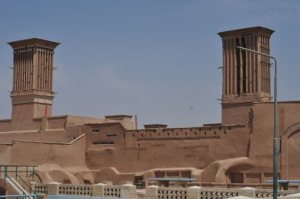
As you wander through Yazd’s side streets, do not be deceived by the restrained façades of its houses. Religious belief has also shaped the architecture. Their exteriors express simplicity, discretion and humility; step inside, however, and you encounter richly conceived and finely detailed interiors. The rooms were also built in harmony with the seasonal cycle. In a region where temperatures range from forty-five degrees Celsius to minus twenty, rooms were positioned according to the changing angle of the sun in summer and winter.
A world formed from broad courtyards, pools, coloured stained glass and mirrored reflections… In the courtyard of our hotel, an elongated rectangular pool with an indigo-blue floor lies before traditional rooms. Accompanied by the santur, Iran’s traditional stringed instrument, a melancholy voice rises in song. Tea in hand and eyes closed, you sip the moment itself.
ALEXANDER’S PRISON
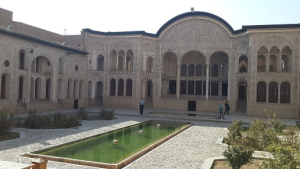
This fifteenth-century domed brick building was once used as a school and is known as Alexander’s Prison. It is said that the celebrated poet Hafez travelled to only two places in his lifetime, rarely leaving Shiraz, the city of his birth: Yazd and India. In Yazd, the desert climate so oppressed his spirit that he could endure it no longer and returned to his beloved Shiraz, writing a poem about Yazd called ‘Alexander’s Prison’. An older legend reaches back to Alexander himself: after invading Iran with his armies, he is said to have sent princes and princesses from a kingdom near present-day Tehran to Yazd, leaving them to die in the deep well in the school’s courtyard. This, the story goes, is how the building acquired its name.
BEYOND YAZD: KASHAN AND MEYBOD
The value of water in the Yazd region becomes vividly clear when you see an ice house. Resembling the domes of Harran’s beehive houses near Urfa, these earthen storehouses were once used to make and preserve ice. We visited one in Meybod, seventy kilometres north of Yazd.
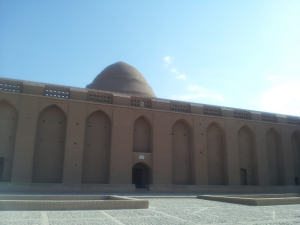
How did the system work? At the centre of the storehouse was a large pit, supplied with water from open pools outside. During winter, the water froze in the cold of the night and remained frozen by day in the cool interior. As only a slender beam of sunlight entered through the apex of the dome, a little more water could be added to the pit each morning. Night after night it froze, layer upon layer, eventually forming an iceberg. In the dim interior, windcatchers known as badgirs created air circulation and brought in fresh air. Meltwater drained through a hole at the bottom of the pit, preventing stagnant water from collecting and limiting the growth of microorganisms. Once the ice reached a certain height, it was broken into smaller pieces and carried to people’s homes, supplying the community with water until the end of summer.
Kashan lies roughly four hundred kilometres from Yazd, and no visit there would be complete without seeing Fin Garden. It is a place where ingenious systems devised in response to harsh natural conditions immediately catch the eye. Completed in 1560, the garden is once again filled with cypresses—a tree of particular significance to Zoroastrians, its evergreen foliage symbolising immortality. Interconnected pools run through the park, their water flowing without the use of a single mechanical pump.
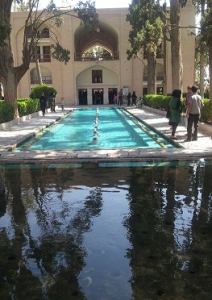
The garden contains buildings that reflect the rich architectural tradition of Kashan, their surfaces adorned with finely carved marble. One pool before a historic building is especially captivating. Its floor contains more than a hundred openings: some send jets of water upwards, while others draw water down, together creating a natural, continuous movement across the surface. It is said that the pool was once lined with gold; when sunlight fell upon the water, patterns reminiscent of a Persian carpet shimmered across the façade of the building opposite. It is impossible not to marvel at such refined aesthetics and skilful engineering, handed down across the centuries.
All rights reserved. Excerpts may be quoted with proper attribution.
August, 2013
Dilek Ekşi Bilgin
@hayyalsen